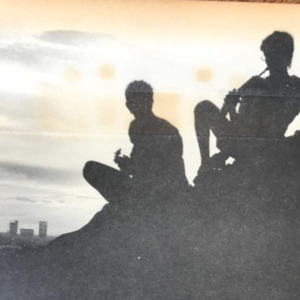
Your actual Californian, Marin County blues

Bryan Thomas wrote a nice article about Led Zeppelin’s stay in the very rustic stone house called Bron-Yr-Aur in the boonies of Wales. Relates Plant in Hammer of the Gods, “Zeppelin was starting to get very big and we wanted the rest of our journey to take a very level course. Hence the trip into the mountains and the beginning of the ethereal Page and Plant. I thought we’d be able to get a little peace and quiet and get your actual Californian, Marin County blues — which we managed to do in Wales rather than San Francisco.” Imagine if they’d actually come to the Bay Area? What do you think would have happened?

Posted in Reviews | Leave a comment

Potpourri

My friend Ivan Morley gave me this photo of a shop called Potpourri that his parents ran in the late ’60s-early ’70s I believe. It was located near the USC campus just south of downtown Los Angeles and the building apparently no longer exists. He said they sold tickets there to the nearby Shrine Auditorium. Anyone know any more about this store?


Here’s a close up of the poster hanging in the window. John Mayall with Junior Wells and Taj Mahal Sept. 6th and 7th. It even says “tickets available at Potpourri.”

Posted in Reviews | Leave a comment

Dream Dancer

In the late ’60s Douglas Adams was a member of the El Paso, Texas psych group Wailing Wall, playing rhythm guitar and singing. When the group split in the early ’70s, Adams made his way out to California in his VW bus. At a folk club called the Holy City Zoo he met his future wife, De Ann, forming a troupe that combined De Ann’s dancing with Middle-Eastern-inspired instrumentals. The two eventually got married and moved to Marin County.
Meanwhile Adams was still concentrating on his own compositions, both on guitar and on the fiddle. In 1977 he booked some time at a recording studio in San Anselmo called the Church (where Country Weather had recorded a couple years earlier). He called the resulting album Light Rain. It’s a pretty fascinating record, full of some rootsy, still-Texas inspired numbers, but also with tinges of exoticism and echoes of English folkies like John Martyn. I’ve been playing the album’s final track “La Vienta” on my show the last couple weeks and getting lots of positive response re its fine writing and Adams’ haunting voice. His next record, Dream Dancer, combined Adams’ interests in folk and Middle-Eastern music and is a fine example of the “ethno-psych” sound that the kids are so crazy for these days, yuck yuck. We love it. Adams didn’t stop there either. He’s continued to record music in that same vein up until this day. If this sounds good to you (and it should!), check these pages here and here for way more detailed stories of Adams’ adventures. Pretty cool stuff.

Check out this footage of Douglas and De Ann down by the Embarcadero in San Francisco in ’73.


Posted in Reviews | Leave a comment

Do the Hump!

There’s a great little piece on the Sopwith Camel over at the Pondering Pig complete with cool news clippings like this ‘un. Our good friend Stephen Ehret of the Wildflower claims them as the best band on the scene. Unfortunately their in-town trajectory was halted for being out in New York for too long recording; for actually having a “hit record;” and for being on the same label as the Spoonful when Zal Yanovsky and Steve Boone ratted out Bill Loughborough for selling them weed. In a Flamin’ Groovies interview for Cream Puff War way back in ’91, Roy Loney claims to have been in jail that night too, also for pot. “I was with the guy they turned in I think,” he says. Was Loney friends with Loughborough? Who knows? Cyril Jordan goes on to claim the guy “had an in with (Bill) Graham” and that’s what got them blacklisted. I remember also reading somewhere Loughborough being cool about the whole thing… kids will be kids, or something to like that. There’s a image of the court report for the case I saw somewhere online a while back but I haven’t been able to find it again. Someone?

Anyhow, this group’s omission from the “head” canon is a crime. The Camel should not be overlooked!

For a listen check out the Fog podcast from June 22 for a bunch ‘o unreleased demos the guys did in ’66.

Zal Yanovsky and Stere Boona
Posted in Reviews | 1 Comment

Kusama’s Self Obliteration with The C.I.A. Change

A film exploration of the work and aesthetic concepts of Yayoi Kusama, painter, sculptor, and environmentalist, conceived in terms of an intense emotional experience with metaphysical overtones, an extension of my ultimate interest in a total fusion of the arts in a spirit of mutual collaboration.

I was introduced to the Citizens for Interplanetary Activity (C.I.A.) through my old friend Ted Berk. Ted was a poet and occultist, and lived in Brooklyn near the Pratt Institute in the early 60s while I was living on St. Marks Place in the Village. I lived down the street from what became the Electric Circus, around the corner from the Fillmore East and across the street from The Five Spot. From 1961 to 1964, I had done several early film projects, in regular 8mm and in 16mm, with Ted before he had gone to Mexico, and then moved to California.

The C.I.A. (I believe they added the “Change” to their name when they went on the road to come to New York) was founded some time in early 1966, Ted and I believe, by Win Hardy*, the lead guitarist and vocalist. He was originally from Lexington, Kentucky, where his father owned a funeral home. Ted first performed his poetry with the band at a gig in Portland, Oregon at the Pythian Hall on Friday, March 3, 1966, on a bill with The Jook Savages and the Multnoman Electric Band, with lights being done by the Retinal Circus. Later, from March 21-26, the band performed at the Rock Garden on Mission Street in San Francisco, on a bill with Big Brother and the Holding Company and Arthur Lee’s Love.

The C.I.A. Change came to New York perhaps around September 1967, just as I was finishing up the editing of the visual for the “Kusama’s Self Obliteration” film, which was scheduled to be premiered at the Fourth International Experimental Film Festival in Knokk-Le-Zoute, Belgium, that December. As we remember, the band came to perform at the Fillmore East with another group, from San Francisco called the Salvation Army. C.I.A. Change stayed on to perform at the Fillmore as an opening act for Procol Harem, and then later for Simon and Garfunkel. (!) After my meeting with the band, they agreed to do a soundtrack for the edited film. I arranged an after-hours session at the Apostolic Studios of Vanguard Records with Matt Hoffman, and old friend and fellow filmmaker, who worked as a sound engineer there.

We screened the film in the studio on a 16mm Bell and Howell and the band improvised as we ran the film a second time. We recorded it on 1/4” tape. On piano, sitting in with the band, was Paul Kilb, an actor / writer / friend, who was the star in “Twice A Man”, a short film by Gregory Markopoulos. One or two others, whose names we cannot recall, who occasionally worked with lighting behind the band as “aurora Glory Alice”, provided “Liquid Sounds” for the mix. What these “liquid sounds” consisted of, we have no idea. We were prepared to record other takes and do remixes, but upon hearing playback, everyone agreed that the track was perfect as it was. That track was what was married to the visual in the release print and it is what you have on this record. The band returned to San Francisco after this, and their spell at the Fillmore “self-obliterated” there, as it were.
-Jud Yalkut
Dayton, Ohio, August 2000

More here on an LP issue of the soundtrack

Posted in Reviews | Leave a comment

Eclection with Dorris Henderson

Fantastic interview with singer Dorris Henderson from a 1968 issue of the British magazine Zigzag.

Eclection page 1 Eclection page 2

Henderson grew up in Los Angeles and decided to pursue a folk singing career after seeing Odetta perform at the Ash Grove. Armed with an autoharp and a copy of Alan Lomax’s The Folk Songs of North America, she began performing wherever she could. At a health food restaurant in Topanga Canyon she caught the attention of Lord Buckley, and she became part of his act in Hollywood. A move East to New York City threw her into the same Greenwich Village melting pot as Fred Neil, Bob Dylan, and Paul Simon, (whose “Leaves That Are Green” she covers on her first single). You can even catch a glimpse of her in Pennebaker’s Don’t Look Back. Visiting her brother in England (he was stationed there in the Air Force),  Henderson met up with John Renbourn at the Roundhouse pub in Soho. The pair hit it off and went on to record the albums There You Go (1965) and Watch the Stars (1967). When Renbourn formed the Pentangle with Bert Jansch and Jacqui McShea, Henderson became a free agent and was quickly snatched up by Trevor Lucas’s group Eclection, to replace the Australian singer Kerrilee Male who’d had enough of show biz.

Posted in Reviews | Leave a comment